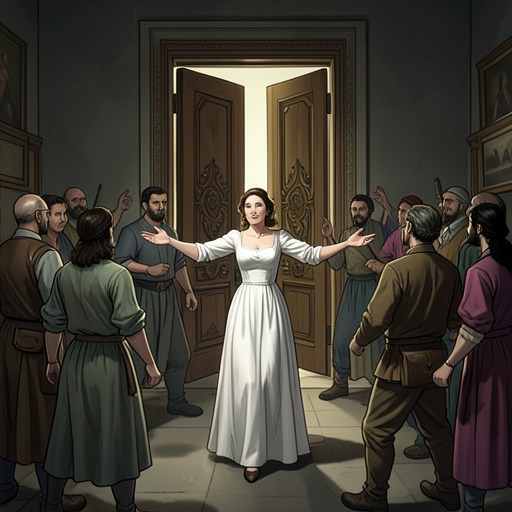
Sophia Jex-Blake School of Medicine for Women
Poor ThingsThe Sophia Jex-Blake School of Medicine for Women represents a concrete opening in a medical profession that the book depicts as tightly restricting women’s access to training and authority. Victoria McCandless enrolled there in 1886, after the narrative had framed women’s medical education as an emerging possibility; her later career makes the school a pivotal point between aspiration and practice.
Identity and Historical Context
The school is identified as a women’s medical institution in Edinburgh. The account places its emergence amid a shortage of women doctors: Baxter says that Britain then had only four, all holding degrees from foreign universities. He links changing opportunities to the Enabling Bill of 1876 and the work of Sophia Jex-Blake, reporting that Dublin University had opened its doors to women medical students and that Scottish universities would soon have to do the same.
This framing makes the school part of a wider challenge to the profession’s existing boundaries. Women’s participation is not presented simply as a matter of individual ambition: the narrative also questions how medical knowledge is taught and who is permitted to exercise it. Baxter argues that doctors should be recruited from nursing or begin their training in nursing, giving practical care a foundational role rather than treating it as subordinate to medical authority.
Victoria McCandless’s Enrolment
On 2 September 1886, the woman who had married Archibald McCandless under the name Bella Baxter enrolled at the school under the name Victoria McCandless. The change of name and the act of enrolment together mark a new phase: the figure previously encountered as Bella enters a formal institution as Victoria, taking up medical study after a life whose origins and identity are disputed within the book’s layered account.
The school’s significance is sharpened by the narrative’s attention to women’s practical medical capacities. Baxter recalls that Bella had worked as receptionist and assistant at his free veterinary clinic, meeting patients and learning to stitch wounds. He regards her skill as evidence that women should not be excluded from intricate medical work. That experience is not described as a substitute for formal medical education; it supplies a practical background against which her later enrolment acquires force.
Training, Qualification, and Practice
The evidence distinguishes Victoria’s enrolment at the Edinburgh school from her later qualification. In 1890, she was made a Doctor of Medicine under the name Victoria McCandless by Glasgow University. That same year she opened the charitable Godwin Baxter Natal Clinic near the Cowcaddens, staffing it with local women whom she trained. The account therefore traces a passage from women’s medical education to a clinical institution of her own, while naming two different institutions at successive stages of her career.
Before that outcome, Baxter proposes a practical route towards medical work: Bella might train as a nurse in an east Glasgow infirmary and, if she did well, progress to assisting him as a theatre nurse. He imagines such experience preparing her for medical-college lectures, whether in Dublin or Glasgow. The passage presents this as a plan, not as an account of training she actually completed at the Edinburgh school; the later chronology separately records her enrolment there.
Narrative Significance
The school’s place in the book is brief but consequential. Its appearance turns debates about women’s eligibility for medicine into a dated institutional milestone, and the difference between Victoria’s enrolment in Edinburgh and her Glasgow qualification preserves the distinctions in the account rather than collapsing them into a single educational event.
The wider narrative also questions the hierarchy that made formal medical authority the measure of expertise. Baxter praises nursing as a central healing practice and describes hospitals as institutions in which the poor could be made to bear the costs of medical training. Against that background, the school signals access to professional education, while Victoria’s later clinic and the women she trains extend the question from entry into medicine to who can provide care and pass medical skills on.